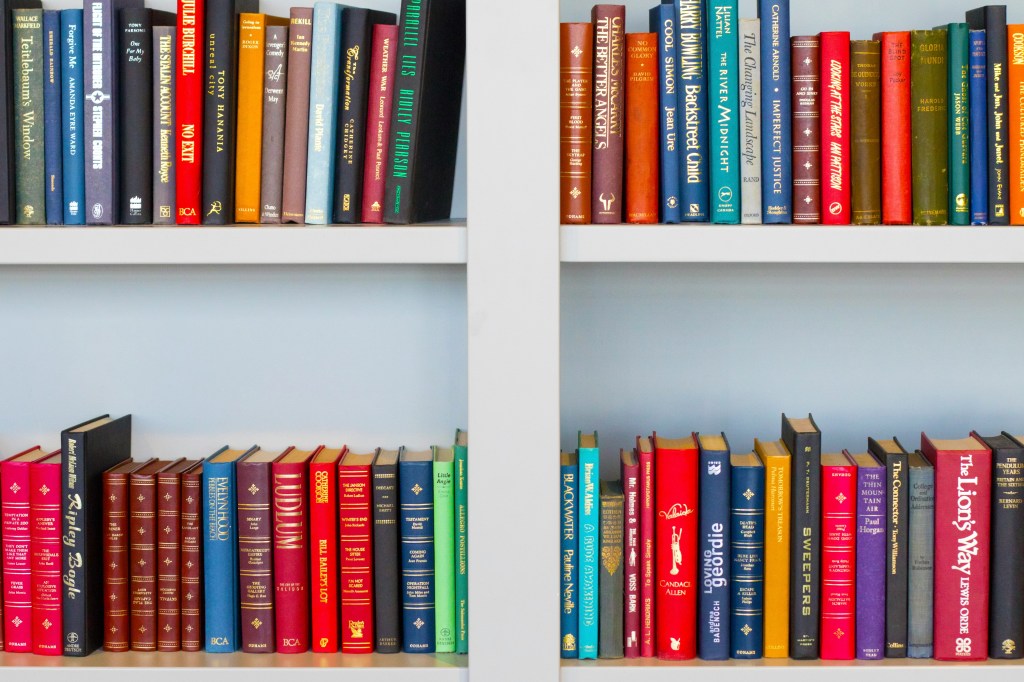
Books are beautiful things. Actually, no, they really are more than things. They are works of art, windows to life, receptacles where someone has poured part of their soul. Being surrounded by good books can be a thrilling experience in itself, but avid readers often find themselves facing space limitations or moving houses too often. So, what to read and what to keep? These are questions I find myself pondering way too often.
First of all, it’s tempting to think that being around books actually makes us more connected to them. It’s easy to confuse the fantasy of reading a book with the reality of it. We can be drawn to the covers and the images in book marketing; we might like seeing the books on our bookshelves, but the reality of reading is a slower, more time-consuming process. In the end, it’s just us face to face with the words in black and white, going places in our imagination. The time and the headspace to do this are the real limitations, however fast we read.
The first step to decide which books you should buy, read, and eventually keep is to ask yourself, ‘what do I get out of this?’
I have found that, from a book, I get out the following:
- Reading it for the first time. I can never know if it’ll go right or wrong. I read, explore, and finally make my own mind about it. It doesn’t matter how well-recommended a book is. In the end, it’s about me taking the leap to read it and hopefully connecting with it. Sometimes it happens, sometimes it doesn’t. I love Little Women, and I didn’t get into The Sound and the Fury. I like to know why people love the latter, but it is the former that will remain in my library. That’s life.
- Rereading. I like the idea of rereading fiction, but I don’t have the time for it. I always love rereading some fantasy books like Harry Potter or The Lord of the Rings. The reality is that I haven’t done it for more than a decade. Still, I find it both useful and heartwarming to go back to a book that I loved reading and at least skim it to refresh my memory.
- Style reference. Sometimes I enjoy dissecting books that are close to my genre and tone. I want to understand how Dickens created such a memorable beginning in A Tale of Two Cities or how Neal Stephenson introduces his universe in Snow Crash. Other times, I need to check some format particularities, and I use books in my genre to see what different publishers have gone for.
- Studying (for non-fiction). Whether the study is linear or scattered, whether there’s rechecking and re-reading really depends on the book. If it’s a book that I like to keep getting back to, that’s a keeper. Some writing manuals, like Robert McKee’s Story, I’ll always have with me.
- A nice cover art can enhance my reading experience. Some people go as far as keeping the book just for the cover.
Maybe there’s one more benefit. Some books act as a reminder, a source of inspiration that makes them worth keeping. After all, we keep paintings and posters because they make us feel good when we pass by them. Sure, at some point we contemplate them, but it isn’t often. We mostly have them in the background, and we enjoy that. Maybe a book reminds you of a person, or of the feeling you had when you read it. Maybe it keeps reminding your brain that there’s something out there you don’t know. And here is when Umberto Eco has a lot to say:
It is foolish to think that you have to read all the books you buy, as it is foolish to criticize those who buy more books than they will ever be able to read. It would be like saying that you should use all the cutlery or glasses or screwdrivers or drill bits you bought before buying new ones.
There are things in life that we need to always have plenty of supplies, even if we will only use a small portion.
If, for example, we consider books as medicine, we understand that it is good to have many at home rather than a few: when you want to feel better, then you go to the ‘medicine closet’ and choose a book. Not a random one, but the right book for that moment. That’s why you should always have a nutrition choice!
Those who buy only one book, read only that one and then get rid of it. They simply apply the consumer mentality to books, that is, they consider them a consumer product, a good. Those who love books know that a book is anything but a commodity.”
While the quote is beautiful and comforting, books are objects after all, maybe a more elevated type of object, like paintings or pieces of furniture, but objects nonetheless. And like other objects, you should keep the ones that make you happy, or that give your life meaning in some way.
While Umberto Eco and other intellectuals like Nassim Nicholas Taleb celebrate having books they haven’t read, I celebrate reading books I already have. I find it very healthy to reconcile your present self with what you have decided to buy in the past. You can gain confidence from reading what you had planned to read. Otherwise, it’s also healthy to give it away if you’re not reading it, to accept that this book isn’t for you, and to let it go, a bit like some people do with their clothes. Not every book or sweater is worth keeping.
During some of the happiest periods in my life in Edinburgh, I’ve only had one book in my bedroom: the one I was reading. I had absolute trust that I would find the next book when it came, and I had very little need to hold on to what I had.
How did this happen? Because getting a new good book in Edinburgh was extremely easy and cheap. I could either go to a charity shop and find some amazing books I wanted to read for two or three pounds. I had what I needed within easy reach, which meant I could enjoy the lightness and space in my house. There was also the great Edinburgh University Library. The feeling of having options and being inspired by what I didn’t know was something that I always had available when I walked around the library corridors. Having good bookstores and bookshops can make all the difference when it comes to deciding which books to buy or keep. In the Netherlands, with their paid-membership library model, this becomes a bit complicated. But they do compensate with a lot of free little bookshelves in the streets.
In short, you should have the reserve of books Umberto Eco talks about somehow, in either your library or others’. To find a good match with a book, to find the right timing to read a book can be a delicate art, and you want options when that happens. When you finish a book, there’s that wonderful moment of achievement that drives you towards the next one, so it’s nice to have the next book ready as soon as possible.
The next natural questions are, “What books should I have available?” What should I read next? There are again a few criteria I’ve found for myself here:
- Books that I need to read for research. If you are a writer like me, I find that these books are the ones I should get to as soon as possible. Notice the word “should.” I can be distracted by something shinier that I bought recently or something that’s already on my bookshelf, so I don’t have to make an effort. Also, sometimes I just want to read for pure entertainment purposes.
- Books from an author I’ve heard many good things about, classic or contemporary. An important note here: there can be quite a range in quality among an author’s works. I know my books are wildly different, if not in quality, at least in tone, so I know that some of them are too harsh for some readers, while others are perfectly cozy for everyone. When it comes to deciding which book to read from an author, it pays off to do a bit of research about which book to try by an author you’re interested in. Normally, a quick search online does the trick.
- Presents. Some writer friends told me they give these books higher priority so they can talk to the giver about them and tell them how much they enjoyed them. What can I say? They are better people than me. I must confess some of the books people have given me were so bad that after I read them or tried to read them, I gave them away with no shame. That’s my belief: if it’s a present, you can do whatever is best for you with it, and sometimes that means getting it out of your bookshelf.
- Books I bought directly from other authors. This is a special category. When an author is doing a book signing event, especially if they are a friend, I’d buy the book either there or beforehand. Having your book signed by an author, however famous they are, is something special. So, sure, I might have dozens of other books to read first, but I don’t let these opportunities pass me by. Incidentally, signing books for other people is something I love and do with great dedication. Very often, the surprised reader tells me, “Oh, you’re writing another novel.”
Now comes the question: what if you have a signed book that you didn’t like at all? These things happen. Again, it’s your book, so do whatever is best for you. If the book is by a friend of mine, I normally keep it because I like the person who wrote it. Other times, like when a friend gives me a book in a language I don’t speak, I tear the dedication page and give the rest of the book away.
And that’s my final thought. I never feel sad when I give a book away, be that to a friend or anonymously through a street bookshelf. Someone out there might enjoy the books immensely. They might share it with even more people. Rather than letting it gather dust on my bookshelf, I’d rather give it a second life.
What do you do with the books you’ve already read? How do you decide what to read next? Let me know in the comments. I’m always curious to know about the habits of other fellow readers!

